The Platform
A self-hosted platform that runs a portfolio of AI-powered apps — designed solo, built spec-first with AI coding agents.
Problem
Shipping several small AI-powered products as one engineer means every app re-solves the same problems: AI provider access, cost control, deployment, monitoring, conventions. And LLM APIs bill by usage — one runaway loop in a hobby app can cost real money. The goal: run many small apps without rebuilding infrastructure each time, and without ever letting AI spend go unmetered.
Solution
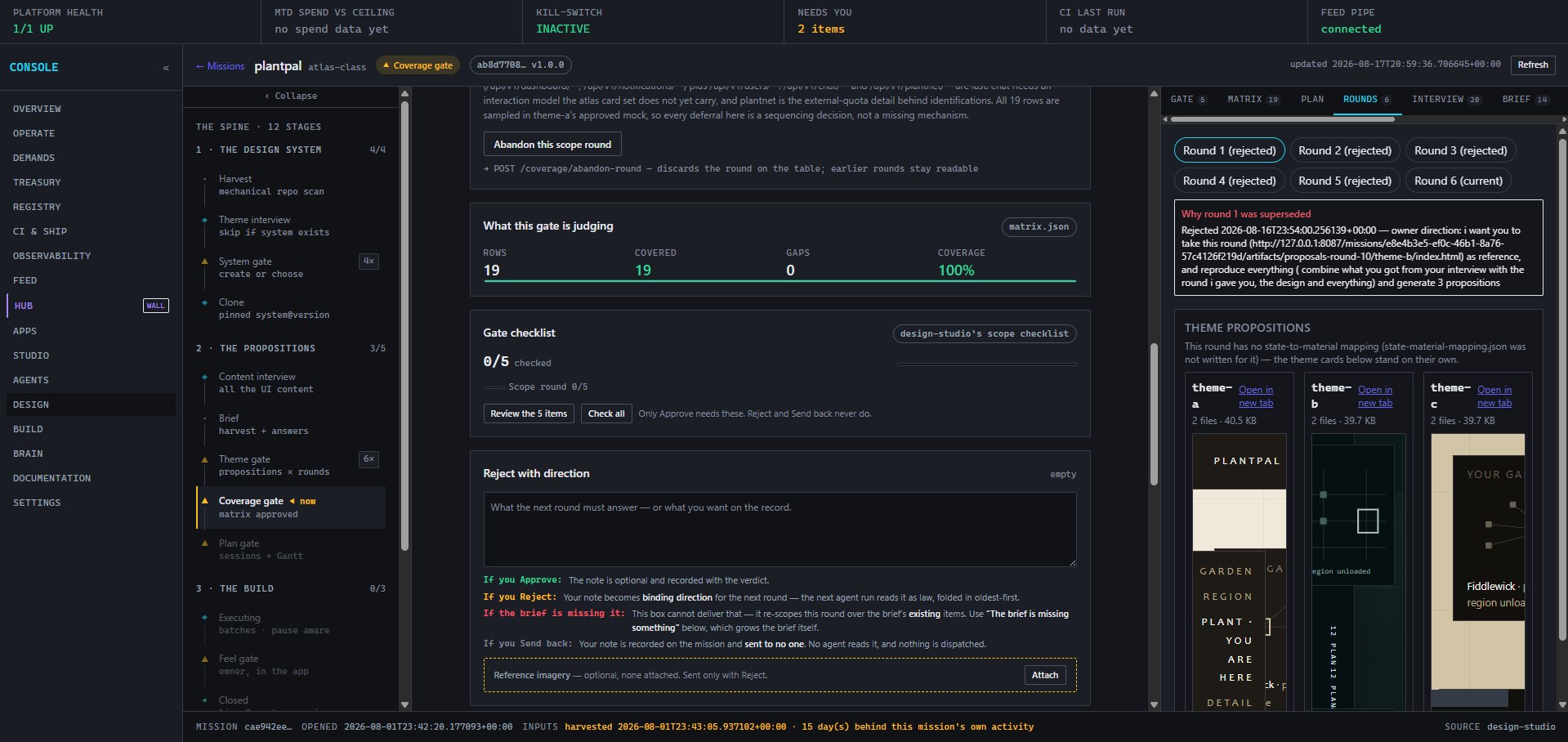
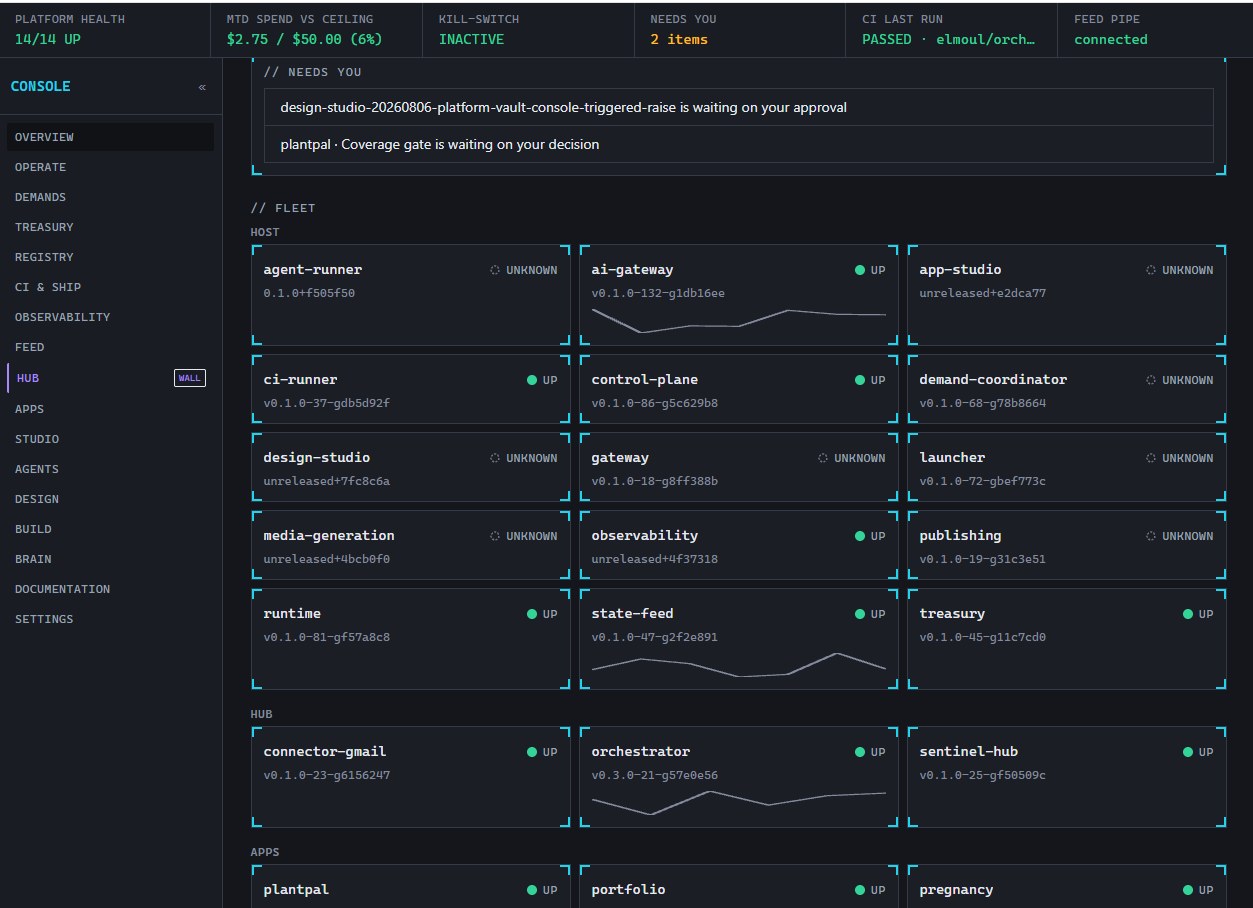
A personal platform of small single-purpose services, each in its own repository with self-describing metadata, all sharing one version-pinned contracts library. Every AI call flows through a single AI gateway that alone holds the provider keys, which makes cost control architecturally impossible to bypass: a synchronous pre-flight budget check before each call, asynchronous usage events over Kafka after it, and automatic downshift to a free local model when spending nears a ceiling. A control plane owns the app registry and scaffolds new repositories from templates; everything runs local-first on Docker Compose and streams live state over server-sent events to swappable dashboards. The platform is also an experiment in method: each repository is built by an AI coding agent working from a written spec, with decision logs and human review gates — software about running AI, built with AI. As the fleet grew, the method grew its own infrastructure: agents in different repositories coordinate through a demand protocol — a repo that needs something from a sibling raises a formal request, a coordinator service validates and dispatches it, and a human approves the result — and every repository carries a persistent operational memory (session journals, decisions, a queryable knowledge base) so each agent session starts where the last one ended. A design studio built on the same rails produces the visual themes the platform’s apps ship with.
Features
- One AI gateway holding all provider keys
- Budget ceilings with synchronous pre-flight cost checks
- Automatic downshift to local models near a spending ceiling
- Self-describing repositories scaffolded from templates
- Version-pinned shared contracts across every service
- Live platform state streamed over server-sent events
- Cross-repo agent coordination via a gated demand protocol
- Per-repo operational memory so agent sessions build on each other
Architecture
- Apps
- AI gateway — sole key holder
- Budget pre-flight
- AI providers / local models
- Usage events over Kafka
- Live state feed
- Dashboard
Tech
- Java
- Spring Boot
- Angular
- Kafka
- PostgreSQL
- Docker Compose
- Server-Sent Events
- Hexagonal architecture
- AI coding agents
Challenges
- Making cost enforcement impossible to bypass rather than merely discouraged — solved structurally: only the gateway holds provider keys, so there is no path around metering.
- Keeping dozens of small repositories consistent as a solo engineer — solved with a conventions library, repo templates and a compliance validator.
- Evolving shared contracts across many consumers without breakage — solved by publishing them as a pinned, versioned package.
- Coordinating changes that cross repository boundaries when every agent works inside exactly one repo — solved with the demand protocol: requests are files, dispatch is a service, approval is human.
Lessons
- Boundaries enforced by structure beat boundaries enforced by discipline: a rule the filesystem enforces cannot rot.
- Spec-first, agent-built development works when the spec is the source of truth and a human holds the review gate.
- Metering belongs at the choke point, not in every app.
Future work
- Move from local-first to hosted once the first product goes commercial
- More apps on the same platform rails
- A richer live visualization of platform state